





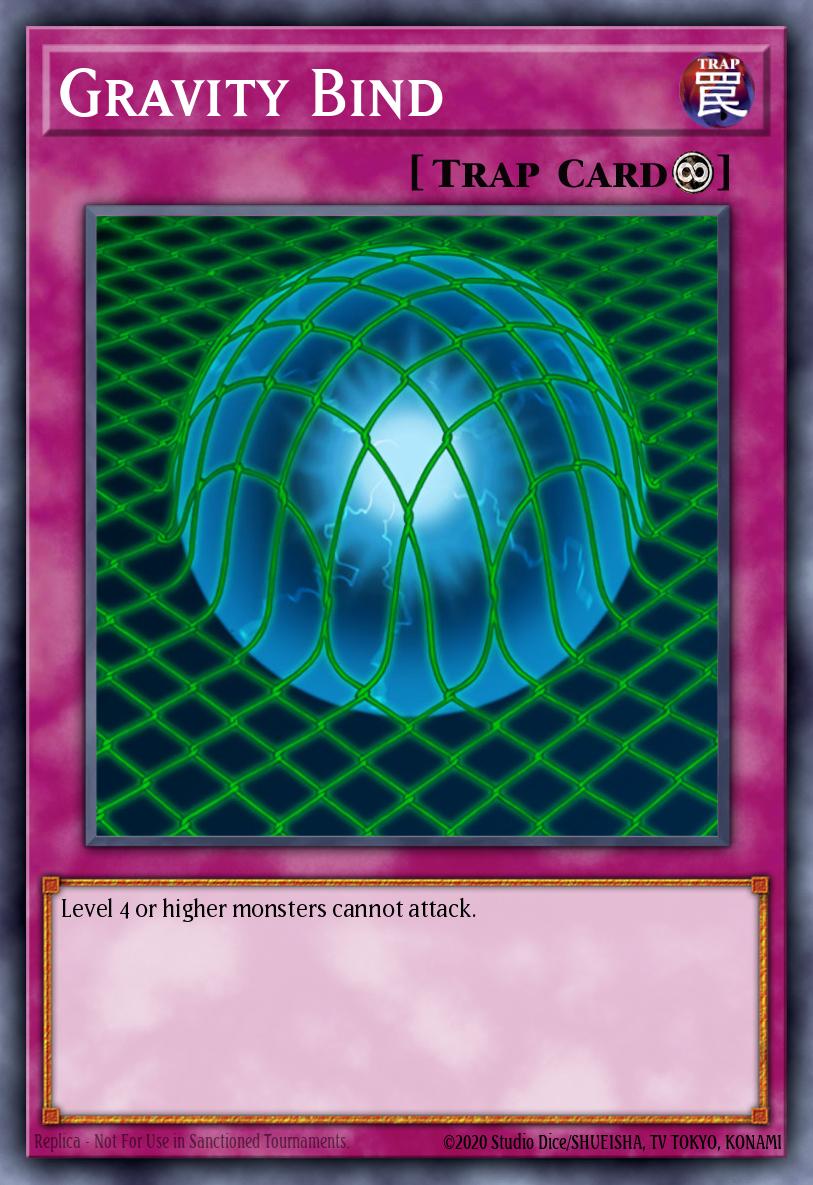


Gravity Bind — Power Evaluation
Final Score: 60 ± 6 · Confidence: Medium
- Intrinsic: 61 · Deck: 59 · Meta: provisional
- Primary role: Floodgate/Control · Secondary: Board breaker
Why it scores here
Gravity Bind does one job: while it is face-up, Level 4 or higher monsters cannot attack, which turns off the largest attackers in the format without needing a target. Its score comes from that restriction plus a one-copy, archetype-free slot that fits 94 different archetypes across 265 recorded decks. It has no combo evidence, no card advantage and no material value, so those axes stay low. High ATK on the monsters it stops does not add points; only the restriction itself counts.
Axis scores
| Axis | Score | Evidence |
|---|---|---|
| Accessibility | 55 | A trap with no searcher route in the evidence, but it is run in 265 decks across 94 archetypes at about 1.46 copies each, so it is reliably available in practice (observed). |
| Combo & Conversion | 15 | The text places no monster and creates no board, and combos_evidence records zero appearances, so conversion is nil on its own (inferred). |
| Resource Economy | 20 | A one-for-zero set trap with no draw, search, or recovery in the text, so it gives no card advantage (verified). |
| Effect & Interaction | 72 | The restriction stops every Level 4+ attacker while it stays face-up, a strong and hard-to-remove floodgate against that class, but it does nothing against Level 3 or lower attackers or non-attack damage (verified). |
| Material Utility | 5 | Not a monster, so it is never Material and provides no Level or attribute value (verified). |
| Resilience & Flexibility | 55 | A continuous trap stays on the field across turns, but it can be removed by trap removal and only covers one monster class (inferred). |
| Deck-Building Efficiency | 80 | One slot at typical 1-copy use with no garnet or self-lock, and it fits any deck without needing an archetype (observed). |
Calculation
Weight profile: 0.7 Floodgate/Control + 0.3 Board breaker. Intrinsic ≈ 61, Deck ≈ 59, Meta = provisional. Modifiers: none. Final formula: 0.40*Intrinsic + 0.60*Deck
Strengths
- Stops every Level 4+ attacker while face-up, the main threat class in the evidence's decks
- Continuous trap that stays on the field across turns
- Generic, archetype-free slot that fits 94 archetypes and is run as a one-of in most decks
- Runs alongside top staples Mirror Force, Swords of Revealing Light and Magic Cylinder in 21-31% of decks
Weaknesses
- No combo presence (zero appearances), so it converts nothing into a board
- Gives no card advantage and no material value
- Restriction does not touch Level 3 or lower attackers or non-attack damage
- Only legal in GOAT copy limits in the evidence (legal_copies: goat 2)
Counters / choke points
- Level 3 or lower attackers, which the restriction does not cover (verified)
- Non-attack damage and effect-based damage routes (inferred)
- Removal of the continuous trap itself (inferred)
Best use
Floodgate against Level 4+ attackers. Decks: Trap-staple and floodgate builds across the 94-archetype sample, especially alongside Mirror Force, Swords of Revealing Light and Magic Cylinder. Suggested copies: 1.
Evidence & gaps
- Verified: Text: Level 4 or higher monsters cannot attack; Frame: Trap Card, Continuous; Formats: TCG, OCG, MasterDuel; legal_copies goat: 2; Not a monster, so no material value
- Observed: Run in 265 decks across 94 distinct archetypes; Average 1.46 copies per deck; 176 decks run one copy; Main-deck in all 265 decks; no side-deck usage; Top partners: Mirror Force 31.3%, Swords of Revealing Light 28.7%, Magic Cylinder 27.2%; Usage statistics: Flamvell 100% inclusion at 1 typical copy; Top-card context: not a top card
- Inferred: Floodgate role is real but narrow, limited to Level 4+ attackers; Resilience is limited by trap removal and single-class coverage; Deckbuilding cost is low because the card needs no archetype or garnet
- Data gaps: no combos supplied; combo conversion is text-only inference no guides supplied no dated metagame sample; meta_power is null no searcher or access-route data for accessibility